


There Will Always Be a Reason to Worry
One of the more interesting things about the third quarter was how little the equity market seemed to care about the long list of things investors had to worry about.
Interest rates moved higher. Inflation remained a concern. Oil prices surged. Geopolitical tensions continued. And yet, U.S. stocks moved to new highs while the economy and corporate earnings remained relatively strong.
That doesn't mean these concerns aren't important. They are. But markets rarely wait for every concern to be resolved before moving forward. Sometimes the risks receiving the most attention ultimately matter less than expected. At other times, something that receives very little attention becomes the next big story.
This is one reason we don't believe investors need perfect conditions to make progress. Businesses adapt, economies adjust and markets continuously incorporate new information. A sound long-term investment strategy shouldn't depend on getting every economic forecast right or knowing which headline will matter most six months from now.
As we look ahead, there will undoubtedly be plenty for investors to debate. Our focus is on putting those developments in perspective and making decisions based on what we know about a client's goals, time horizon and financial circumstances—not on trying to predict which concern will ultimately win the day.
The third quarter offered a good reminder: there will always be reasons to worry, but that doesn't mean there aren't also reasons to remain optimistic.
.png?width=1520&upscale=true&name=Annette%20Bio%20(3).png)
Resilience in the Face of Rising Headwinds
The third quarter of 2026 saw rising interest rates, renewed inflation concerns, and heightened geopolitical uncertainty. Yet, there was an unusual divergence: economic growth and corporate earnings remained relatively strong, even as higher oil prices, persistent inflation and rising interest rates created what appears to be an increasingly challenging backdrop for investors.
U.S. equities returned 1.5%, while non-U.S. equities declined -0.5%. Bond markets faced greater pressure as yields moved sharply higher around the world, pushing U.S. core bonds down 3.4%.
The U.S. Economy Remained Resilient, Despite Flashing Warning Signs
U.S. economic growth remained resilient, supported by consumer spending and business investment. AI-related investment in data centers, semiconductors and related infrastructure remained an important source of growth, while corporate earnings continued to exceed expectations and provide fundamental support for stocks.
The labor market also remained relatively healthy, although signs of softening became more apparent. Unemployment edged higher, as hiring remained subdued while consumer confidence and labor showed signs of weakening. On balance, however, the economic data provided little evidence that a recession was imminent.
Inflation – and Interest Rates – Returned to Center Stage
The combination of resilient economic growth and renewed inflation pressures changed the interest-rate outlook during the quarter. In September, the Federal Reserve raised its target rate by 0.25% – its first increase since July 2023 – reversing earlier expectations that the next meaningful move in rates would be lower.
As per the graph below, yields have moved up meaningfully across the curve over the last year with most of the increase concentrated in the third quarter.
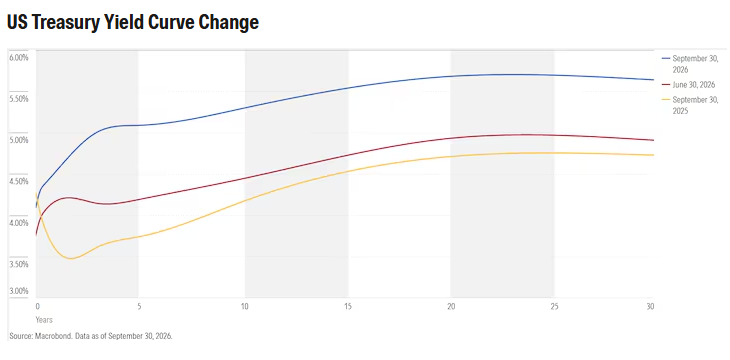
Fed communications reinforced its commitment to keeping inflation expectations anchored, signaling that a rapid return to rate cuts is off the table. Investors will continue to watch inflation, employment and economic growth for clues about the path of monetary policy.
The bond market, however, did not wait for the Fed. The 10-year Treasury yield rose roughly 0.8 percentage points during the quarter and finished above 5%, reflecting not only inflation and monetary policy concerns, but also growing attention to federal borrowing, fiscal deficits and heavy private-sector demand for capital.
The result was a difficult quarter across fixed income markets, with U.S. core bonds declining 3.4%. The silver lining is that higher yields improve the prospective income and return potential of bonds going forward, creating a more attractive starting point for long-term bond investors.
Geopolitics Came with an Economic Price Tag
Continued conflict in the Middle East and threats to energy supplies pushed oil prices sharply higher, adding another complication to the inflation outlook. Brent crude rose roughly 40% during the quarter, ending above $100 per barrel.
Trade tensions and tariffs remained another source of uncertainty, while the Russia–Ukraine war continued without a durable resolution. These developments are difficult to predict, but their potential effects on inflation, economic growth and corporate costs are relatively clear.
Stocks Climbed the Wall of Worry
Despite higher rates, rising oil prices, and geopolitical uncertainty, U.S. equities posted a positive return during the quarter, with the S&P 500 reaching record highs. Strong corporate earnings – particularly among large U.S. technology companies – provided fundamental support for the market. Earnings growth also outpaced stock-price gains in many areas, allowing valuations to moderate even as equities advanced.
The broad market's modest return masked significant differences beneath the surface. Energy was one of the strongest-performing sectors, benefiting from higher oil prices, while several rate-sensitive and economically sensitive sectors struggled. This dispersion reinforced the importance of looking beyond headline market returns. See graph below.
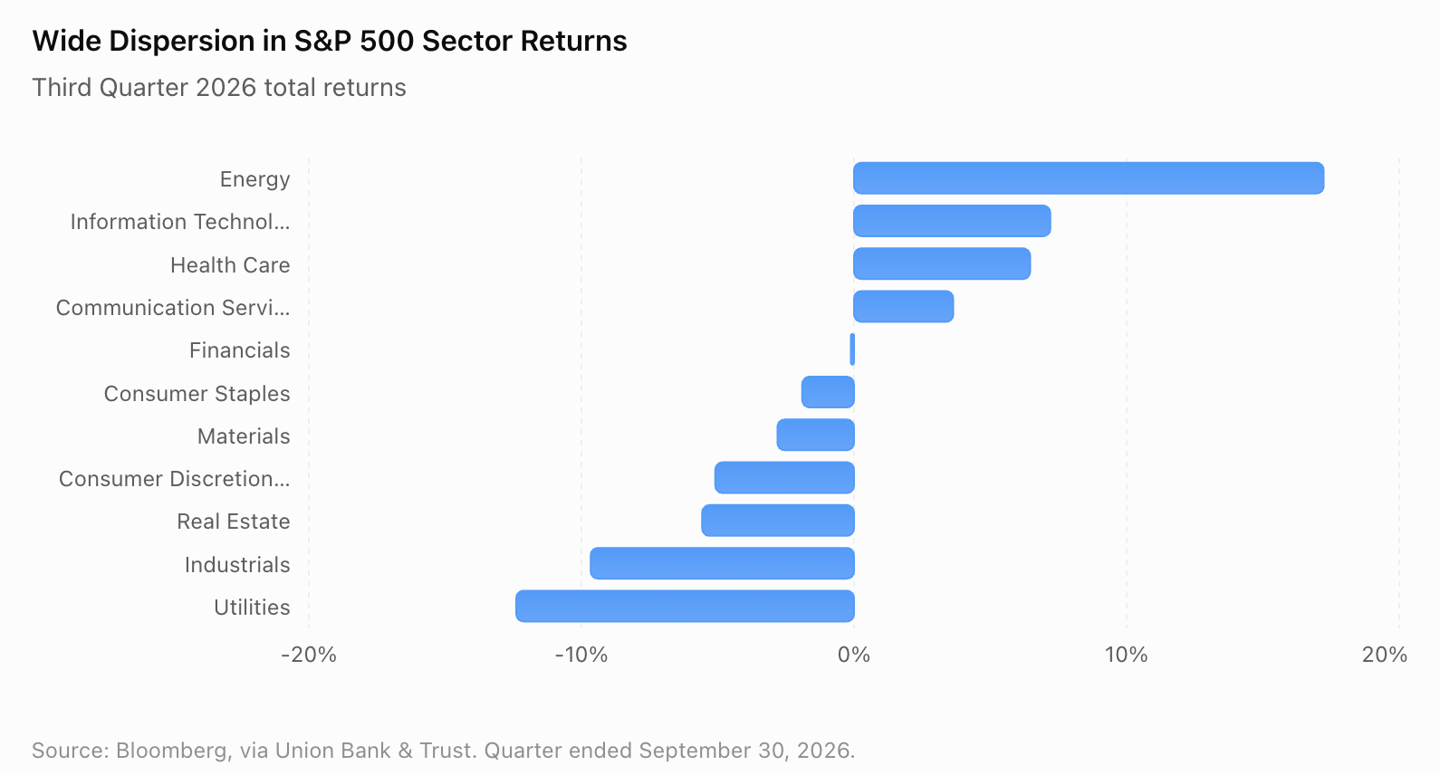
Non-U.S. equities were generally more subdued during the quarter. Developed international markets posted modest gains while emerging markets weakened after strong performance earlier in the year. Both remained ahead of U.S. equities year to date, highlighting the value of maintaining exposure across a broad range of markets.
Looking Ahead
Where do interest rates go from here?
Inflation, energy prices, employment and economic growth will remain important indicators for the Fed. At the same time, fiscal deficits, Treasury issuance and demand for capital will increasingly influence longer-term interest rates.
Can corporate earnings – and AI investment – continue to support stocks?
Strong earnings have been a critical counterweight to higher interest rates and geopolitical uncertainty. With expectations high and market performance concentrated among a relatively small group of companies, investors will be watching the breadth of earnings growth.
AI-related capital spending has become an increasingly important driver of U.S. economic growth and corporate earnings. The key question is whether today's extraordinary investment ultimately translates into sufficient revenue and profits. The spending plans of the largest technology companies could have implications well beyond the technology sector.
Geopolitics, energy and trade remain wild cards
Middle East tensions, oil prices, the Russia–Ukraine war and U.S.–China relations all have the potential to influence inflation, economic growth and monetary policy. Tariff and trade policy could also affect inflation, corporate costs and global supply chains.
And, of course, Washington
The November 3 midterm elections will determine control of Congress and could influence expectations for fiscal, tax, and regulatory policy. Federal borrowing and deficits are also receiving greater attention as heavy Treasury issuance coincides with unusually large private-sector financing needs, particularly for AI-related infrastructure.
Staying Focused When the Headlines Are Loud
There is no shortage of uncertainty facing investors, but uncertainty itself is nothing new for financial markets. Rather than attempting to predict the next move in interest rates, oil prices, geopolitics or the stock market, we believe investors are best served by maintaining diversified portfolios aligned with their long-term objectives.
Periods of uncertainty inevitably create winners and losers, often in unexpected places. This is why we believe in the importance of diversification, discipline, and resisting attempts to time short-term market movements.
Quarterly performance reports will soon be available on the Orion client portal.
Click here!Your Liberty Wealth Team – News and Updates
As Liberty Wealth Advisors continues to grow and expand, it's important that we build out our team of qualified professionals to support the important work we do for our clients. We are delighted to announce that we welcomed our new colleague, Jack Kornutik, to the team in September. Jack joins us as a Financial Advisor, serving our clients with Mike Parry in our Stamford, CT office.

You can read more about Jack here. Please join us in welcoming Jack to the team!
-1.jpg?width=1520&upscale=true&name=Comparison%20chart%20(1)-1.jpg)
This information does not constitute legal advice. Prime Capital Financial and its associates do not provide legal advice. Individuals should consult with an attorney regarding the applicability of this information for their situations.
Advisory products and services offered by Investment Adviser Representatives through Prime Capital Investment Advisors, LLC (“PCIA”), a federally registered investment adviser. PCIA: 6201 College Blvd., Suite 150, Overland Park, KS 66211. PCIA doing business as Prime Capital Financial | Wealth | Retirement | Wellness | Family Office | Tax Advisory | Endowments & Foundations. Tax planning and preparation services are offered through Prime Capital Financial Tax Advisory.
Private Client Services and their associates do not provide legal or tax advice. Individuals should consult with an attorney or tax professional regarding the applicability of this information for their situations. Securities offered by Registered Representatives through Private Client Services, Member FINRA/SIPC. PCIA and Private Client Services are separate entities and are not affiliated.